
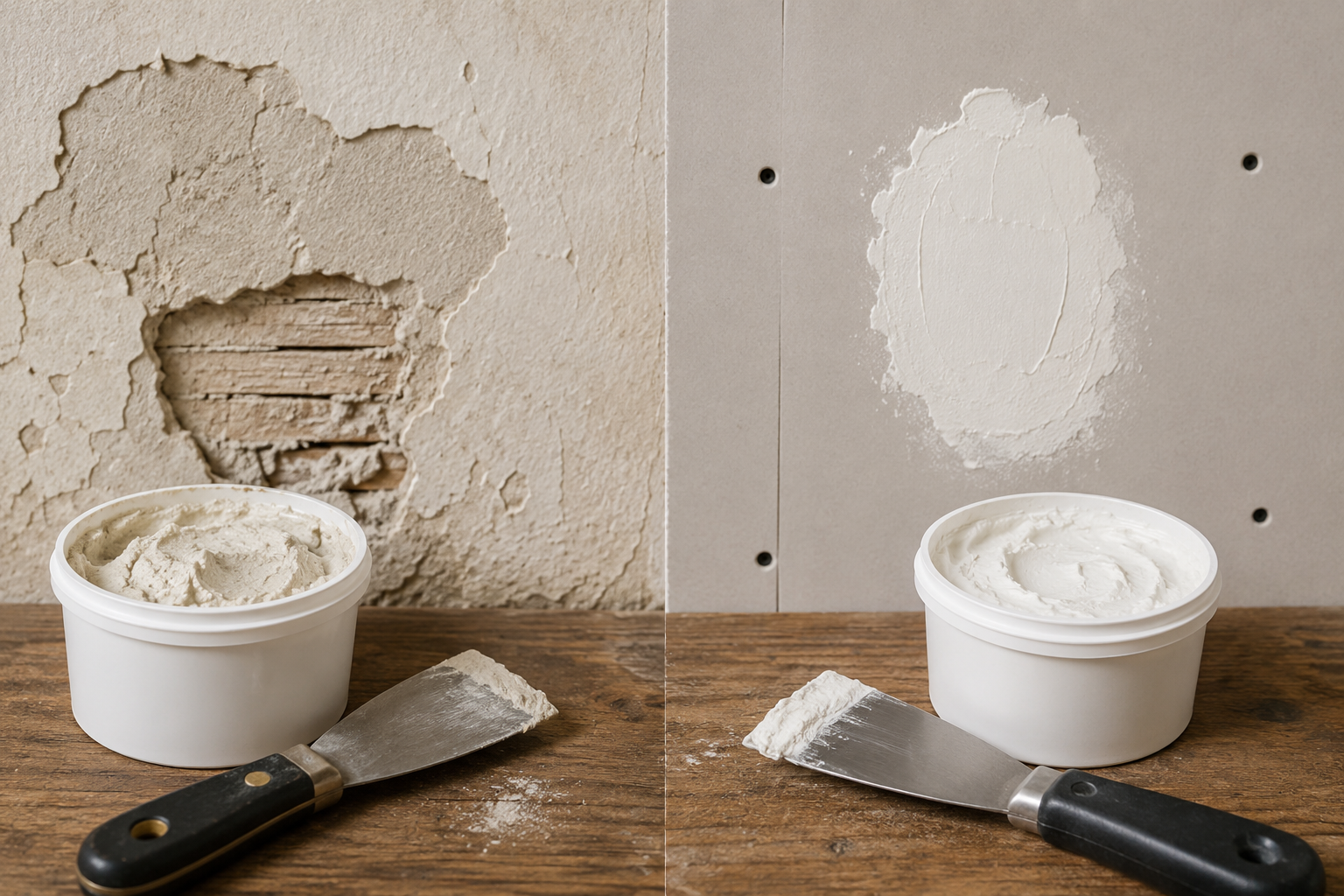
A small crack appears above a doorway. A few inches of plaster have broken away near a window. In another room, a drywall seam has started to show. At first glance, all three problems can look like simple holes that need filling.
That is where many wall repairs go wrong.
The material used for a repair should match the wall beneath it. Plaster repair compound vs drywall filler is not simply a choice between two products that do the same job. Each material has different properties, applications, and limitations.
Understanding the difference can help homeowners avoid weak patches, visible repairs, repeated cracking, and unnecessary work.
Key Takeaways
- Plaster repair materials are designed to work with plaster surfaces and their specific characteristics.
- Drywall fillers and joint compounds are mainly intended for drywall finishing and minor repairs.
- The wall type, damage, surface condition, and desired finish should guide material selection.
- Historic plaster often deserves careful repair rather than replacement with modern drywall materials.
What Is the Difference Between Plaster Repair Compound and Drywall Filler?
Plaster repair compound is intended for repairing or rebuilding damaged plaster surfaces, while drywall filler is generally designed for filling and finishing drywall.
The two materials can both help create a smooth wall, but they behave differently. Traditional plaster creates a harder surface and is commonly associated with older homes and historic construction. Drywall joint compound is softer and easier to sand, making it useful for finishing drywall seams and covering small imperfections.
That difference matters when selecting a repair material.
A product that works well on a drywall panel may not provide the right performance on an older plaster wall. Likewise, using a harder plaster material for a simple drywall finishing task may add unnecessary complexity.
The goal is not simply to fill the damaged area. The goal is to create a repair that works with the existing wall.
Understanding Plaster Repair Compound
Traditional plaster walls have a different character from modern drywall. They can feel solid and dense, and older homes may have multiple layers that contribute to the finished surface.
Plaster itself can be made using materials such as lime or gypsum mixed with water. Once prepared, it forms a paste that hardens into a firm surface. Traditional plaster was widely used in older construction and remains important for restoration work.
A plaster repair compound is therefore selected with the existing plaster system in mind.
It may be appropriate for problems such as:
- Cracks in plaster walls
- Small holes and damaged areas
- Missing sections around previous repairs
- Deteriorated plaster surfaces
- Repairs where the existing texture needs to be preserved
The exact product should depend on the type of plaster and the repair required. Surface preparation also matters. Loose or damaged material may need attention before a new repair compound is applied.
What Is Drywall Filler?
Drywall filler is a general term homeowners may use for products designed to repair or finish drywall. Depending on the job, this can include joint compound, patching compounds, or other suitable fillers.
Drywall joint compound is commonly used to cover seams between drywall panels. It can also fill nail holes, screw holes, dents, and some minor cracks. After drying, it can generally be sanded to create a smooth surface before painting.
This makes drywall filler especially useful for everyday interior wall repairs.
For example, a homeowner installing shelves may create several small screw holes. A suitable drywall filler can help hide those holes before the wall is touched up.
That is a very different repair from rebuilding a section of loose plaster in a century-old home.
Plaster Repair Compound vs Drywall Filler: Key Differences
The simplest way to understand plaster repair compound vs drywall filler is to compare what each material is designed to accomplish.
Feature | Plaster Repair Compound | Drywall Filler |
Main use | Repairing plaster surfaces | Repairing and finishing drywall |
Typical surface | Traditional or plaster-based walls | Gypsum drywall |
Hardness | Generally designed for a harder plaster system | Generally softer and easier to sand |
Common repairs | Cracks, holes, missing plaster | Holes, seams, dents, minor imperfections |
Application | Requires attention to existing plaster | Often straightforward for small drywall repairs |
Sanding | Usually less forgiving | Generally easier to sand |
Historic walls | Can be appropriate when compatible | Not automatically suitable |
Best approach | Match the existing plaster system | Match the drywall system |
The comparison is useful, but the wall itself remains the most important clue.
A damaged plaster wall should not automatically be treated like drywall simply because both surfaces eventually receive paint.
Why Wall Compatibility Matters
One common misconception is that any wall filler can be used anywhere.
That approach can create problems.
Imagine a homeowner sees a narrow crack on an old plaster wall. The crack appears small, so a general-purpose filler seems like an easy solution. The repair may look acceptable after painting, but the material may not behave like the surrounding plaster.
The issue is not always the product itself. It is the relationship between the repair material and the existing surface.
Plaster can have different layers, textures, and levels of deterioration. A successful repair begins by understanding what is already there.
This is especially important in older houses. Historic plaster can contribute to the appearance and character of a room. Removing it unnecessarily may eliminate details that are difficult to reproduce.
A Simple Framework for Choosing the Right Material
Homeowners can use a simple four-step framework before beginning an interior wall repair.
1. Identify the Wall
First, determine whether the surface is traditional plaster or drywall.
Older homes may contain plaster, while many newer homes use drywall. However, age alone should not determine the answer.
2. Examine the Damage
Look closely at the problem.
Is it a small nail hole, a surface dent, a crack, or a section where the wall material has broken away?
The size and condition of the damage can affect the appropriate repair approach.
3. Check the Surrounding Surface
The existing wall should be stable before a repair begins.
Loose, crumbling, or poorly bonded material can make a simple patch more complicated.
4. Match the Repair Material
Choose a product designed for the wall system and the type of repair.
The objective is a stable repair that blends with the surrounding surface rather than simply covering the visible defect.
Common Plaster and Drywall Repair Mistakes
Even straightforward wall repairs can become frustrating when the wrong approach is used.
Treating Every Wall Like Drywall
Not every smooth interior wall is drywall. Older homes may have plaster surfaces that require a different repair method.
Choosing a Filler Only Because It Is Easy to Sand
Easy sanding is useful, but it should not be the only consideration. Compatibility with the existing wall matters more than convenience.
Ignoring Loose Material
Applying filler over unstable plaster can leave the underlying problem untouched.
A repair should begin with a sound surface whenever possible.
Making the Patch Too Obvious
A repair can be structurally sound but still look poor if its texture does not blend with the surrounding wall.
The final finish should be considered from the beginning.
Removing Historic Plaster Without a Reason
Older plaster may be part of a home’s original character. Where the existing material can be properly repaired, preservation may be preferable to unnecessary removal.
Real-World Example: An Older Detroit Home
Consider a homeowner preparing an older Detroit house for renovation.
A bedroom wall has several cracks near a doorway. In another room, there is a small hole where an old fixture was removed. Both areas may look like ordinary patching jobs.
A closer inspection, however, reveals that the bedroom has traditional plaster while the other area has drywall.
Using the same filler for both repairs would ignore the difference between the wall systems.
The plaster repair should be approached as plaster restoration. The drywall hole can be handled using a compatible drywall patching material.
The finished walls may look similar after painting, but the repair process behind them is not necessarily the same.
That distinction is one reason material selection should happen before the patching begins.
When DIY Repair Makes Sense
Small, stable repairs can sometimes be manageable for homeowners with basic repair skills.
A small drywall hole or minor surface imperfection may require little more than appropriate filler, a putty knife, careful application, sanding, and touch-up painting.
Plaster can be more demanding.
Older plaster may have hidden deterioration, loose sections, previous repairs, or unusual textures. A crack that looks minor from the surface may also deserve closer inspection when it keeps returning.
DIY work should therefore be based on the condition of the wall, not simply the size of the visible defect.
When Professional Plaster Repair Is the Better Choice
Professional help becomes more valuable when plaster is loose, extensively cracked, deteriorated, or historically significant.
A professional can evaluate the existing surface and determine whether the problem is limited to the finish or involves deeper damage.
For homeowners searching for a Plaster Repair Expert Detroit MI, the priority should be experience with the actual wall system, careful preparation, and a repair approach that respects the existing structure.
Professional plaster restoration can also be useful when the goal is to preserve the appearance of an older home rather than replace original materials unnecessarily.
Do This, Not That
Do This | Not That |
Identify the wall type first | Assume every wall is drywall |
Match the material to the surface | Use one filler for every repair |
Remove or stabilize loose material | Patch over unstable areas |
Consider the existing texture | Focus only on filling the hole |
Preserve sound historic plaster when practical | Remove original plaster without assessment |
Follow the product’s application directions | Assume every compound behaves the same |
How Professional Plaster Repair Supports a Better Finish
A good repair is about more than making damage disappear.
Preparation, material compatibility, application technique, drying, and finishing all influence the result. Plaster repair can also involve matching the existing surface so that a repaired area does not stand out after painting.
For larger repairs, recurring cracks, deteriorated plaster, or historic interiors, professional assessment can reduce the risk of treating the symptom while missing the underlying problem.
For homeowners considering professional plaster wall repair or restoration, In The D Construction provides services suited to residential remodeling and restoration projects.
Frequently Asked Questions
Is plaster repair compound the same as drywall filler?
No. They may both be used to repair wall surfaces, but they are intended for different applications. Drywall joint compound is commonly used for drywall seams, holes, and surface finishing, while plaster repair materials are selected for plaster surfaces.
Can drywall filler be used to repair plaster?
It depends on the specific product and repair. A material intended for drywall should not automatically be assumed to be appropriate for traditional plaster. The wall condition and product instructions should guide the decision.
Which is easier to sand, plaster or drywall compound?
Drywall joint compound is generally easier to sand. Traditional plaster becomes harder as it sets and can require more skill to work with effectively.
When should a homeowner hire a professional for plaster repair?
Professional help is worth considering when plaster is loose, repeatedly cracking, extensively damaged, or part of a historic interior. A professional assessment can help determine whether repair or more extensive restoration is appropriate.
Does plaster repair require replacing the whole wall?
Not necessarily. The appropriate solution depends on the condition and extent of the damage. Sound plaster may often be preserved while damaged areas are repaired.
Conclusion
Choosing between plaster repair compound vs drywall filler starts with one simple question: what type of wall needs repair?
Drywall filler is generally suited to drywall finishing and common minor repairs. Plaster repair materials are intended to work with plaster surfaces and can be more appropriate for damaged or historic plaster.
The best repair is not always the fastest one. It is the one that respects the existing wall, uses compatible materials, and creates a durable finish.
For homeowners dealing with significant plaster damage, historic interiors, or recurring wall problems, professional guidance can help protect both the appearance and character of the property.
Summary
Plaster repair compound and drywall filler serve different wall systems and should not be treated as interchangeable materials. Drywall fillers are commonly used for seams, holes, dents, and minor imperfections, while plaster repair materials are better suited to compatible plaster surfaces. Careful wall identification and surface preparation are essential for a lasting repair. When damage is extensive or involves historic plaster, professional restoration can help preserve the existing wall while achieving a clean finish.